
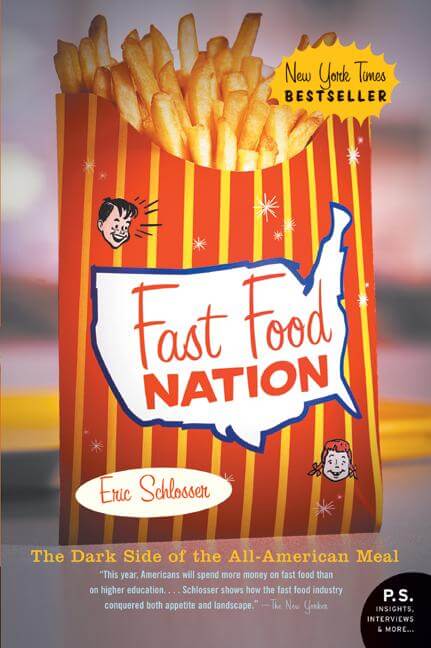
Eric Schlosser examines the birth of fast food culture in this captivating survey of postwar America.
Fast Food Nation reveals the impacts of this industry on our country, taking a hard look at how fast food has lead to the homogenization of our society, hastened the “malling” of our landscapes and lead to the systemic exploitation of the teenage workforce.
Schlosser reveals frightening information regarding the unsanitary conditions of fast food production. He also uncovers the industry’s efforts to entice the youngest consumers, our children, in his dissection of the unholy alliance between the fast food industry and Hollywood.
Finally, Schlosser investigates the symbiotic relationship between American cultural imperialism and fast food and turns an eye toward globalization –a phenomenon launched by fast food.




elana says
Bradford -Thanks so much for your heartfelt and detailed comment! Elana
Bradford says
I heartily endorse your recommendation of Schlosser’s FAST FOOD NATION. It’s another serious argument that we should pay more attention to what we are doing, that we should live more examined lives.
“What we eat has changed more in the last forty years than in the previous forty thousand” (p. 7). The result? “The United States now has the highest obesity rate of any industrialized nation in the world” (p. 240).
Schlosser tells a fascinating tale of how we got into a situation where, for example, we are eating unhealthy, obesity-producing foods often centered around contaminated meat that is primarily caused by “the feed being given to cattle, the overcrowding at feedlots, the poor sanitation at slaughterhouses, excessive line speeds, poorly trained workers, [and] the lack of stringent government oversight” (p. 217).
More importantly, he not only encourages us to think about untangling the web we’ve weaved for ourselves (“There is nothing inevitable about the fast food nation. . . [p. 260]), but also he suggests how. “The first step toward meaningful change is by far the easiest: stop buying it” (p. 269). After all, the executives in charge of the fast food industry surely “will sell free-range, organic, grass-fed hamburgers if you demand it” (p. 269).
Similarly, since “[f]ast food, like the tabloids at a supermarket checkout, is an impulse buy” (p. 66), let’s stop and think about what we are eating. “Americans have long consumed more potatoes than any other food except dairy products and wheat flour” (p. 115). Our bodies did not evolve to consume dairy products, wheat flour, or potatoes!
Let’s follow Schlosser’s suggestions. Let’s stop abusing ourselves and think better about what we are doing.”