Gluten Free Recipes | Elana's Pantry
about|faqs|forums|recipes|ingredients|why almond flour?|gluten free cookbook|classes|press|book tour

« Vegetarian Pad Thai

Raw Kale Shiitake Salad »


The Great Agave Debate


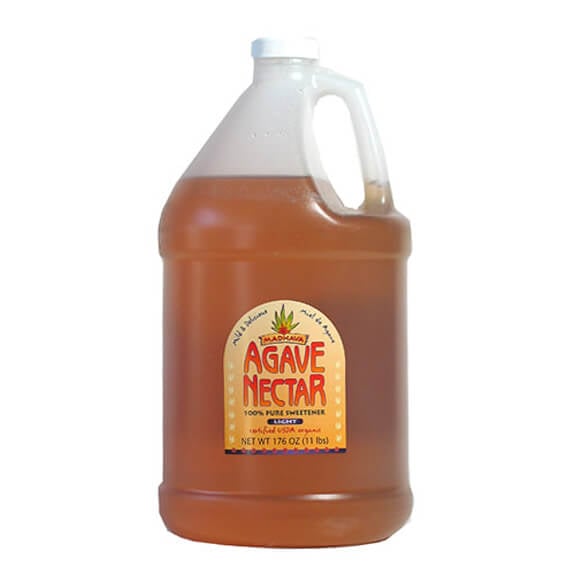
madhava agave nectar light

"Why do you use agave? I've heard that it's very unhealthy"  I'm asked this question about my "go to" sweetener on at least a daily basis.

First off, there really is no perfect sweetener, so I recommend everything in moderation.

We often take sugar and other sweeteners for granted, forgetting that they were not widely available to humans until the modern era (excluding of course, those living in the tropical regions feasting on mangoes and pineapple). Processed sugar was invented between the Medieval Period and the Enlightenment (more than 500 years ago), it became more widely available during the 1400 and 1500's. By 1750 (with the advent of the Industrial Revolution and the invention of sugar mills) sugar became wildly popular.

So if we really think about it, up until a couple of hundred years ago, the majority of the human race (at least those living in colder climes) only experienced the taste of sweetness by eating fruit when it was in season (or when nursing, of course). The fruit that was eaten was not the overly ripe, super sweet fruit that is bred today. Think of wild blueberries --they are tiny and tart. The fruit we eat today has been cultivated for its juicy, sweet flavor.

I think the spike in diabetes and other diseases we have seen during the past decades may partially be due to the fact that humans are not accustomed to eating large quantities of sugar and are not able to efficiently metabolize this substance.

Sugar is sugar. Agave is sugar. An apple is sugar with some good vitamins, minerals and fiber. Basically, many of us (especially those with celiac) would be prudent to monitor our intake of sugar in any form (celiac and diabetes ride on the same HLA gene, so the presence of one increases the likelihood of the other).

While I do use agave in my dessert recipes, I am very cautious about my overall intake of this (and all other sweet substances) because I find that unfortunately, I am one of those whose body rebels against too much sugar. Of course, my husband and children can eat a lot more of this substance than I do and still feel great. That's what keeps me baking like a fiend. They want their treats and they do just fine with them.

For those of you that are now on the anti-agave bandwagon, I have come up with this date sweetened recipe.  Of course, I will still be using agave because I feel ok when I consume it in very small amounts.
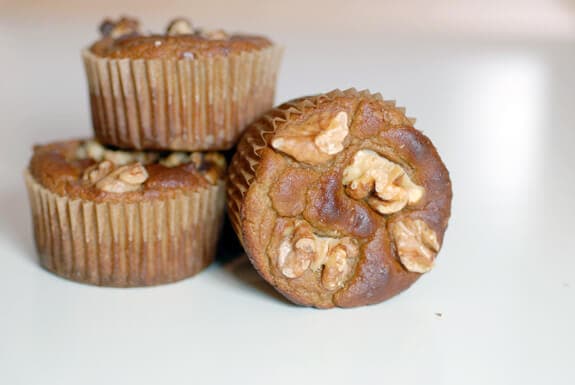
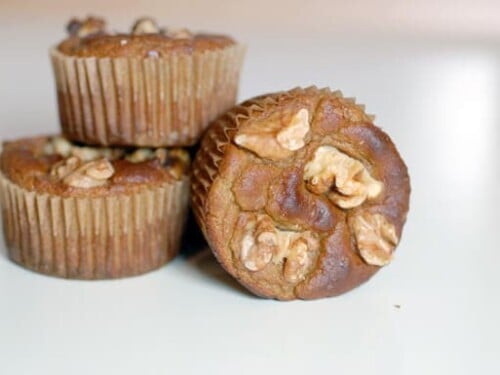
gluten free banana walnut muffins

Banana Walnut Muffinsprint friendly recipe
3 eggs
¼ cup coconut oil
2 medium bananas
3 dates, pitted
10 drops stevia
¼ cup coconut flour
¼ teaspoon celtic sea salt
½ teaspoon baking soda
½ cup walnuts, toasted and chopped

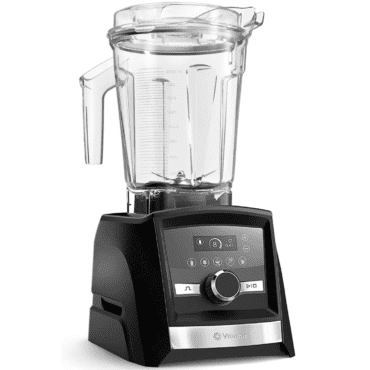
  1. In a vita-mix, combine eggs, oil, bananas, dates and stevia and blend on medium speed until combined
  2. Add in coconut flour, salt and baking soda and blend until smooth
  3. Fold in walnuts
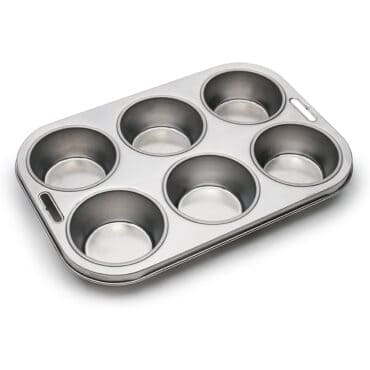
  4. Scoop ¼ cup batter into lined muffin tins
  5. Bake at 350° for 20 to 25 minutes (my batch took exactly 23 minutes, though all ovens are slightly different)
  6. Cool and serve

These tasty gluten-free, Paleo (I think) muffins do not contain agave for all of the agave-phobes out there.  I will be creating some desserts with alternative sweeteners just to spice things up (plus, I like a good challenge every now and then).  However, I will still be using agave for some recipes.

In terms of the great agave debate, I want you all to know that I use Madhava Agave Nectar. While I've noticed a lot of your comments with links to articles about the evils of agave syrup I want to also point out this link posted by one of my readers, Shari, from Madhava's President Craig Gerbore.

On a much lighter note, here's a cool coincidence in regards to agave nectar. The winner of last weeks Freebie Friday is Karen from wrighttherapies.com. She left an interesting comment regarding the controversy over agave nectar on my Asian Salad Dressing post.

Agave or not, have a great weekend!


57 comments leave a comment

  1. Elizabeth

    Sorry Elana but... they had honey, from time immemorial... very old. And Native Americans boiled down maple syrup from we don't know how far back; they used birchbark pots. (And, wild blueberries and other wild berries, when ripe, are really sweet!) There's always been sweetness :D

  2. Elizabeth

    p.s. It must be such a pain to get daily mail about this, when meanwhile, any schmo can figure it out to just substitute an equal amount or so of their preferred sweetener. It's not rocket science. To each her/his own, with all of the choices out there, right? :)

  3. Gina

    I was also wondering why you didn't mention honey, my husband's preferred sweetener, which has been around since bees!

  4. Becca

    I noticed the (very) large bottle of Agave at the open of this post. Where can someone like me purchase something of that size? I am a believer in Agave and hate how much it costs and how often I have to buy another bottle.

  5. Tammy

    Becca, you can order Agave in quantity from Amazon.com, among other sites.

    For those of us with diabetic health issues, agave is a gift from God. It's low on the glycemic index and a spoonful has about the same amount of natural fructose sweetener as an apple. A little goes a long way. The problem is that corn is forced in unnatural ways to be a sweetener (high fructose corn syrup) and is in fact unhealthy, but it's not the fructose, it's the process and the source (grain, not fruit/cactus). People are scared by the term "fructose" but it's one of the only natural sugars that is safe for diabetics (unlike date sugar). And it has no aftertaste like stevia.

    Just thought you need even MORE discussion on your page. :D Thanks, Elena, for a wonderful site!

  6. CoconutGal

    I concur Elana. Everything in moderation, right?
    That is why, I am glad that I cannot tolerate eggs, or I would be baking those muffins and eating half of a batch all by myself :-D
    Nah- I'd trade agave for eggs any day!! Have a good weekend!

  7. donna

    hi
    this is the first i have ever heard agave is 'unhealthy'...in fact everything i had known about it was just the opposite plus the fact that it does not affect blood sugar...as a hypoglycemic it had been a great thing to have around for baking etc..
    we have all heard honey has some benefits but it DOES affect blood sugar..so i only use raw honey very sparingly...i am curious to know what is being said about agave..can someone direct me to where i can find out?
    thanks
    donna

  8. Alchemille @ alchemille.etsy.com

    Elana,
    Thank you for bringing this up!
    It's true that every type of sweetener should be consumed in moderation...And lately I have found (to my big surprise with my life long hypoglycemia) that I do much better with very little to no sugar at all.
    I usually also use half the amount of sweeteners in recipes which gives a minimal sweetness to baked goods & desserts (this upsets my husband whom I tell he can always add more). I prefer eating fresh summer fruits and load up on vitamins!
    We are not meant to thrive on sugar, like we aren't meant to thrive on grains.
    Our ancestors even though they had access to natural sweeteners, didn't enjoy them all year long (unless they prepared preserves or dried their fruits): bees don't make honey during the cold winter, fruits are seasonal (and some are sweeter than others) and maple or birch syrup (which require some work & time to boil down to the right consistency) could only be enjoyed in Northern Countries.
    Lately i stumbled on recipes to make (pancake) syrups out of dried fruits such as raisins, dates or figs (for example), I think they'd make fine homemade sweeteners ;).
    Boiling down fruit juices to make syrups/concentrates is also a good idea (but it takes time and patience).
    If you have a persian/middle-eastern grocery store nearby, you might want to check it out. They carry interesting items such as date molasses, grape molasses, even carob molasses (which I haven't tried).

    • Jenny

      This is a very good comment. People tend to forget just because sweeteners were available doesn't mean people used to gorge on them the way modern human does. The amount of sugar an average human consumes in a day is absolutely ridiculous! (Along with the amount of grains we consume.) Moderation, moderation, moderation :)

      Elana - I am SO excited to try these muffins. Banana nut without agave?!??!?!?! Did you read my mind? This is the exact recipe I've been mulling over in my head to create while too lazy to start experimenting. I can't thank you enough!

    • Diane-Thewholegang @ thewholegang.org

      Great comments. Sugar is so addicting and you can find it in most processed foods, gluten free or not. It's the go to ingredient. I'm with you two in limiting the amount. I too have a sensitive system that really does not take too kindly to sugars. Thank you for the great information and recipes.

  9. Elana, you are so talented! These muffins are beautiful! I'm all out of coconut oil, but I might have to buy some tomorrow just to try these out. :)

  10. Alchemille @ alchemille.etsy.com

    Tammy,
    The sweetener with the lowest glycemic index (and the most sustainable) is coconut sugar...You might want to check it out (it's also rich in minerals).

  11. The Wind Attack @ windattack.com

    I'm all for agave on the basis of taste and how it doesn't give you the sugar rush. However, I also am all for using other sweeteners too. It's all about the flavor and what works best for different recipes. Maple syrup is good for chocolate, agave for fruit, honey with nuts, whatever seems to work best!

  12. donna

    hmmm...now i have to wonder if different kinds of sweet items affect people differently...because i- being hypoglycemic too..cannot tolerate the concentrated sugar in dried fruits very well...i think a syrup made from them would send me thru the roof! i can eat a very small amount of dried cherries or cranberries mixed with nuts...but when i have eaten more in a sitting, alone i always have a huge crash soon after..and i think with something carb-loaded like pancakes i would feel very ill...
    i have never had a problem with agave, nor do i with fresh fruits...very confusing- the whole thing!

    • agave does score low on the glycaemic index, as does xylitol made from birch trees - so this is probably why you don't react to agave.

      Fresh fruit is well tolerated because of the soluble and insoluble fibre which slow down the release of sugars into the blood stream.

      The thing with dried fruit is that we tend to eat a lot more of it than we would if it were fresh and full of juice. A handful of raisins or a pound of grapes - the sugars in the raisins are concentrated and pack more of a punch than even a pound of grapes would.

      Finally, check that your cranberries are not the sweetened kind. If they make your face pucker up like you just ate a lemon, then they are unsweetened. x

  13. Amy Green/Simply Sugar & Gluten-Free @ simplysugarandglutenfree.blogspot.com

    My experience has been that agave doesn't affect my body the way that white sugar does. My best guess is that it has to do with the chemical make-ups of the different types of sugar. Just a guess, I'm not a chemist. I use dates as a sweetner in my baking, too, and they are really good. In the end, I agree that moderation is the key.

  14. lisa

    try xylitol - you get the sweetness without the sugar rush....would appreciate your take on this as a sweetener alternative...lisa

  15. Mir

    well, you can live without sweeteners, our ancestors didn't need them, but we seem to do as we are brought up eating sugar in every silly thing we eat. Though, beyond the question if agave syrup is healthy or not, some people are allergic to it, I get a skin rash with anything that comes from agave, let it be leaves, juice, tequila or syrup.
    Xylitol...I wouldn't put in my mouth anything that came out of a CHEMICAL LAB!!! To me, those things aren't edible.

  16. Alchemille @ alchemille.etsy.com

    Xylitol is highly refined birch syrup...That is if you get the real deal because they managed to make it out of corn syrup in China.
    Why don't you try plain, simple & natural birch syrup?

    Oh and stevia (which is either approved or disapproved by the FDA) has been used as a mean of birth control...Therefore it affects hormone levels and fertility.

  17. I've decided to use local raw honey instead of agave. It will reduce the carbon footprint and support our local economy. Honey is also very healthy when it's raw. It's healing, hydrating, packed with minerals, is very sweet so it goes a long way and it gives bees a reason to live. Without them we all die so let's eat honey instead!

    Xylitol is excellent if you have candida but don't eat too much or you may get diarrhea. It's anti-fungal and not really ideal for most sweetening purposes but it's good in chewing gum and great for ear infections. Don't put the gum in the ears!

    Wonderful-looking muffin recipe.

  18. A

    There are so many different sweeteners available that if someone doesn't like agave, s/he can always use date syrup, rice syrup, maple sugar/syrup, grape sugar, fruit juice concentrates, or honey.

    One thing I suggest for people trying to cut down on sweetener use is to use stevia (the processed sort, not the green sort, as that has a strong almost anise flavour). Stevia can't simply be used in place of syrups in recipes because a much smaller quantity is needed, but it works quite well for recipes where the quantity of sweetener is unimportant (for example: pears simmered in red wine). Stevia also has a bit of an aftertaste (it tastes a bit like artificial sweetener, although stevia is a plant), so I find it is best when about 50% of the sweetener is something other than stevia. Still, that's a 50% reduction in consumption!

    Another thing which I plan to try soon is the so-called 'miracle berry' (Synsepalum dulcificum) which is starting to become available by mail order in the US and Europe. Both this berry and stevia have the advantage of being virtually calorie-free and not having the properties of traditional sweeteners, which makes them ideal for people who are concerned about the effects of sweeteners on their health.

  19. A

    @Alchemille - with stevia, I believe there are studies showing no reproductive effects as well. These are some papers I've seen cited as examples of the other side of the debate (I haven't read any of them):

    Roberts, A., Renwick, A.G., Comparative toxicokinetics and metabolism of rebaudioside A, stevioside, and steviol in rats, Food and Chemical Toxicology (2008)

    Brusick, D.J., A critical review of the genetic toxicity of steviol and steviol glycosides, Food and Chemical Toxicology (2008)

    Wheeler, A., Boileau, A.C., Winkler, P.C., Compton, J.C., Prakash, I., Jiang, X., Mandarino, D.A., Pharmacokinetics of rebaudioside A and stevioside after single oral doses in healthy men, Food and Chemical Toxicology (2008)

    Geuns, Jan M.C. , Safety Evaluation of Stevia and Stevioside, Studies in Natural Products Chemistry, Vol. 27 (2002)

    In the interests of fairness, I believe this is the source of the claims about reproductive impacts:

    http://www.inchem.org/documents/jecfa/jecmono/v042je07.htm

    Unfortunately the debate has been polarized by the "it's natural so it must be good" and the artificial sweetener lobby, so it is difficult to get accurate information.

    Personally I am reassured by the fact that it was used for generations by people in Paraguay (as a sweetener) and has been used in Japan for the last 30-odd years. I think if there were negative side effects in normal use they would have been observed under these circumstances, but of course that is just my opinion.

  20. Elana, I know how you feel. Over the years, I've done my share of posts on why I use agave, etc. Even had Craig, the president of Madhava guest post on my site to address issues (read: false information) that have been circulating around the web.

    It takes a lot of energy to keep up with everything and to try to correct people when they are under false assumptions. So, I decided not to do that anymore except from my blog.

    On the other hand, I've watched over the years (and tracked via Google alerts) how popular agave nectar has become and has grown as a product. Just this week, the New York Times did a little bit on it in terms of bar drinks, but nonetheless...

    Anyhoo, just writing to say thanks for saying your piece.

  21. Mari

    I have "sweets" maybe once a month, so I'm delighted to use agave on that rare occasion. I just wanted to share a few of my favorite uses for agave. For a quick mojito, I use the light agave syrup instead of simple syrup. It works great. I'll have to check out that NYTimes article... Also, I love to use amber agave instead of pancake syrup. My mom always made homemade syrup and so I never really liked maple syrup. The amber agave is delicious and you only need a little bit.

  22. I find it interesting that so much discussion about sugar tends towards a rather judgemental tone. It is a mystery to me why people get so fired up over what other people eat. That said, funny enough there was a post in Cooking Issues today about Agave syrup:
    http://cookingissues.wordpress.com/2009/06/26/margaritaville-with-science-agave-nectar-vs-simple-syrup/
    And there was an article posted a couple of days ago about a study about sweet sensitivity in terms of taste:
    http://www.newscientist.com/article/dn17382-europeans-sweet-tooth-may-have-been-survival-trait.html

  23. donna

    i did not notice a judgemental tone here...just people discussing and i sure hope my posts were not takenas such...no judgement intended- just adding my two cents and thoughts...
    i would love to know more about this 'miracle berry'..that is something i have not heard about before...someone said it is so hard to keep up with everything..it is! it is a full time job!
    i try to vary what i use but use very little sweeteners at all..agave mostly when baking or honey but i only bake maybe twice a month if i am lucky...i cannot stand the taste of stevia..i have tried and tried different kinds and it tastes just like splenda ( YUCK!) to me...and i won't use any chemicals or artificial stuff...
    anyway i think this is a great discussion and i personally am learning from it
    have a great weekend everyone

  24. Kimi @ The Nourishing Gourmet @ thenourishinggourmet.com

    Elena,

    You are so sweet to develop a recipe for those not using agave. :-)

    Personally, I have found that agave did not raise my blood sugar as much as white sugar, so it was great to use when I was dealing with a yeast issue. I only stopped because I became concerned with my body (my liver, actually) having to process so much fructose. I use raw honey mostly now, especially for my daughter because it is supposed to be easier to digest and I like that there is such a long history of use. I also use palm or coconut sugar, which is just as low on the glycemic scale as most agave syrups, but has the advantage of being a traditional sweetener.

    But in the end, I think that moderation is key, like you said. :-)

    For those who don't use agave sweetener but love Elena's recipes (like me!), I have found that honey does very well in them! :-)

    Thanks Elena for all of the hard work you put into your recipes. They are a great treat and I appreciate what you do.

  25. Kimi @ The Nourishing Gourmet @ thenourishinggourmet.com

    Oops! I meant Elana! My daughter's name is Elena, so I always think of your as Elena. ;-)

  26. A

    @Kelly - I hope that everyone knows what foods are best for her/himself, and knows that not everyone's body is the same...so what's good for one might not be good for another. Any discussion within those parameters nice to see.

    @donna - You can read more about miracle berry on Wikipedia http://en.wikipedia.org/wiki/Miracle_berry and two sites which I know of which sell it are http://www.miracleberry.co.uk and http://www.miraclefruitinternational.com

    I like to idea of being able to put much less sweetener into a dish and have it still taste sweet. I have quite a sweet tooth so it would be great to be able to satisfy my cravings without eating lots of sugars.

  27. Erica @ comfybelly.com

    Thanks for clearing this up. I was becoming unsure of what to believe about agave syrup.

  28. Verde

    Wow, what a can of worms to get opened. I've been following sweetener issues for years since I made friends with a family from Guyana and discovered how the world was changed by sugar. It's all still hugely political even now but it certainly was a main motivator of the slave industry and there are still huge slave issues in Brazil (part of why sugar ethanol seems so cost effective there).

    Sugar grown in the United States is either cane (about half) which is mostly controlled by one very politically connected family from Florida (who has much to do with Haiti and the Dominican Republic sugar) or is beet sugar which is now, since last year's approval already around 90% Monsanto product genetically engineered seed which is getting loose and will affect all other beets, collards and other brassicas in the family which includes broccoli, cauliflower, Brussels sprouts, kale, chard, and more via cross-pollination.

    Stevia was outlawed by the FDA at the behest of the artificial sweetener industry which at the time was mainly aspartame (an exito-toxin) which became a Monsanto product and was behind the demonization of saccharine (a product that gave Monsanto its start). Now it's sort of been cleared because Coca-Cola and Carghill have found ways to process it which gives them profitable patents on it (before as a natural product no one could lay claim on it).

    Honey was a European thing that didn't exist in North America before their taking over from the Natives (and maple syrup producing trees don't grow everywhere on the continent). However, bees can only produce as much as they have access to food. These days they are getting fed HFCS-based replacements which really are not good for them. The biggest problem these days with honey (besides the great migration for almonds and other major monocropping but that's a whole post there... and the CCD which currently is most thought to be a Bayer Crop Sciences nicotine based -- and patented -- persistent pesticide) is that most honey comes from China adulterated with many banned in the US pesticides after being laundered through other countries such as Australia and Indonesia. So, unless you know the owner of the bees (and maybe even go so far as to watch it being processed as even raw honey gets heated by some to make it pourable meaning it's no longer raw...) then it's hard to tell where the honey came from and what's really in it (but cheap prices can't be expected either).
    http://www.seattlepi.com/local/394053_honey30.asp
    http://www.sfgate.com/cgi-bin/article.cgi?f=/c/a/2007/10/14/CM2SS2SNO.DTL

    Of course, as you might imagine there's issues with demand causing problems everywhere as there is now monocropping happening with Palms which are destroying rain forests by plantation owned and operated by huge multi-international corps and more. Agave also has problems though what I've heard most is that, as we often do, demand for low prices has made it unprofitable to grow the plants, which take 7 years to mature, so some farmers have burned theirs in protest.

    I think if we all really looked into what we consume and how much it takes to get to us (as well as how it affects the world environmentally as well as socially) we'd be that much more appreciative of our riches and more willing to pay what it's really worth (so others can live at least minimally -- as those in Haiti can't -- and not as slaves -- as those in Africa do so we can have cheap chocolate).

    By the way, as another unsolicited tidbit, agave is not a cactus being in fact more closely related to lilies, onions and asparagus. It also has quite a few nutrients and minerals which refined sugar does not (and brown sugars are just refined with a little molasses put back in for color and moisture).

    As much as I've read, researched and gathered regarding sweeteners, I've never heard agave is bad. I'm interested to hear more now. I'd put money on most of the bad-mouthing being related to astroturf (itself another Monsanto invention) groups paid to look out for industry interests.
    http://www.bermanexposed.org/

    Thanks for the recipes and discussion.

  29. Kimberly@Living Free @ livingfreeforever.wordpress.com

    Good gravy--there is a lot of debate about which sugars to use! I, like you, don't do well with too much of any form of sugar. I use so little, that I just use honey. I can't eat muffins etc. due to not eating eggs. Without baking, I have not really needed 'sugar' for much of anything. Thanks for the info. though!

  30. I was surprised you didn't mention honey, but maybe you were only thinking of manufactured sweeteners?

    For me the problem with any sweetener apart from honey is that it is denatured, condensed, has fibre removed, heated etc. Stevia seems to arouse such controversy that I steer clear of this too.

    Your point about our inability to adapt and metabolise the refined sugar in the modern diet is right on the money though. We should learn to eat seasonally, consume our fruit fresh - (not dried to concentrate the sweetness) and eat very small amounts of added sweetener if we really need it.

    Of course, our sweet tooth is developed at the breast, so we can hardly be surprised that society eats as much sugar as it can lay it's hands on. Our task as folks with an awareness of the negative effects of sweeteners, is to simulate conditions where a mountain of sugar/honey/agave/date syrup etc isn't available in the nearest supermarket to feed our cravings.

    I look forward to more savoury posts Elana - your savoury food always looks fabulous too.

    x x x

  31. A

    @naomi: While I agree that eating fewer sweets is beneficial, I disagree with the assertion that a love of sweets is due to conditioning. Many sources suggest it is innate (consumption of sweet tasting foods has been observed in many cultures which didn't have supermarkets), and there is a genetic component to the degree to which sweet things are desired (see http://www.webmd.com/diet/news/20080514/glutton-for-sugar-genes-get-heap-of-blame ). The problem is, once again, a mismatch between our current environment and our bodies.

    I'm a good argument for nature over nurture. I did not have much access to sugar as a child. Much of our food came from the garden, animals we raised/hunted, or the co-op (which provided things like whole grains). Yet as long as I can remember, I have craved sweets. Even eliminating beet and cane sugar from my diet for a year (and not replacing it with anything) didn't get rid of that craving. This is one of the reasons I want to try the miracle berry--my tastebuds clearly need to be rewired.

  32. Verde

    Wow, I just read up on the piece (I can't call it an article because it's such a hack job) on agave that ran in the Natural News (repeated in the forum here) and I can't even begin to explain all that is wrong with it. It's full of lies, exaggerations and completely false utter spins. There is maybe 5% truth and that's only used to set up the weaving of untruths. As much as I dislike HFCS much of what is written about it even is false and misleading.

    Frankly the only thing for anyone of any conscience to do is just forget they ever saw it and start anew in his/her education. Anything that actually corresponds with reality is apparently only coincidence and to reference the hack job at all in anyway would only serve to confuse more.

    Inulin for instance occurs naturally in sunchokes (Jerusalem Artichokes), garlic, onions, leeks, yams and many other vegetables we are unlikely to give up based on some goofball's ramblings printed by an irresponsible website owner who couldn't be bothered to fact check any of it (I'm referring to the original publisher, the "Natural News" which has destroyed their own credibility by having any association with this let alone being the entire reason for it).

    I'm not sure what the clearly malicious motive is but any brush with reality there might be in that bundle of fiction (complete with fantasy chemistry) is totally accidental in the same way that a broken clock is correct twice a day.

  33. Cassi @ cassifriz.com

    Elana-

    thanks for your reply to this issue that i've also been dealing with concerning agave. it's my preferred sweetener- but considering how often i use sweetener, it is a minor aspect of my diet. yet when talking to clients and other health food people, i'll admit agave is not perfect. it's just the sweetener that works for me and my family.

    we also use honey, green stevia, and molasses for a variety of things. agave works in ice cream and baking in ways the other sweeteners don't always work.

    date based foods also often work as treats for us. i appreciate all the great recipes you provide, as well as the responses to ingredient questions. as a high-protein, non-dairy, celiac with two kids (and one on the way) your style and ingredients really work for my family and we all appreciate that a lot.

    my husband was so shocked when i found your site and made biscotti for him and my son. they couldn't believe that they got such yummy treats from their non-baking mom.... and while they don't expect them, it's always nice to have something once in a while to give them those huge treat-for-me? smiles!

    thanks thanks thanks.
    peace and blessings-
    Cassi

  34. Hello! I was so surprised to have won that book- I just wanted to leave a comment, lol! Well it looks great. How do we get in contact? I checked my email and did not see anything from you...

    Karen

  35. Assays,

    I think you may have misunderstood my comment. I don't think that we are conditioned to want sweet things, I think it's human nature. Nature not nurture.

    What I meant is that we start life - if we are lucky - drinking breast milk, which is inherently sweet. It is in our nature to crave sweetness and fat because these qualities indicate high calorific values and back when we were hunter gatherers, packing a lot of calories in was important.

    Now we are all less active and have food available constantly, but our appetites often have not adjusted to compensate.

    Having said that, it is possible to train yourself away from condensed sweetness by eating foods that are naturally sweet and not eating anything that is processed. Honey, although unprocessed - should be approached with caution because it is so concentrated.

    Intense sugar cravings can often be due to nutritional imbalance, absorption problems or lack of protein and fibre (not carbs, veg and fruit) in the diet. Some cravings are in our heads. I speak as someone who craved and ate sugar for a long time until it made me so ill I had to give up everything refined and all grains in order to restore my health.

    We have to be gentle with ourselves and understand that if there is candy in the cupboard we will want to eat it. If there is only fruit then we can learn to love that instead - but like a drug addiction, it's for life - you can't dabble and expect not to get burnt.

  36. Ninufar

    One of the (many) things I appreciate about Elana's approach is that emphasis on listening to one's own body -- which admittedly I couldn't do until I quit sugar for a while. (For me it's very much like a drug addiction, and it was one o' those 12-step programs that got me through withdrawal and into balance, but I'm sure many health-conscious readers don't have such hard-core food issues.) Some foods are a poor choice for anyone (e.g. deep-fried Mars bars), but that doesn't mean that a single sweetener or way of eating will be "perfect" for everyone.

    Back when someone posted that same Weston Price article on the forums, it was funny to see how another commenter w/the same concerns as me has found an opposite solution. My body does best on a GF/CF/sugar-free high-complex carbohydrate mostly-vegan path; tons of grains and beans and veggies. Concentrated fructose syrups apparently trigger psych. and phys. symptoms for me in a way that applesauce doesn't. (thank G-d!)

    What the no-grain commenter and I have in common -- which likely explains why we both find Elana's recipes so appealing -- is a reliance on real food!

    So thanks!

  37. debby

    Thanks Elana for the recipe. I use agave nectar in everything and love it. It's better for me than sugar. I shop for large bottles here.

  38. Thanks for bringing this up. I find that it works well for me to use small amounts of agave in my recipes as long as I keep sweets to being a rare treat. Although it is true that a variety of sweeteners have been used throughout history, they have never been as cheap, abundant and easy to use as they are today.

  39. Tracey Anderton

    I am in the UK and love Elana's recipes - we have Sweet Freedom here which is a syrup made from 100% fruit -not sure if you have it in US yet? It tastes like sugar with a lot less calories and you use upto 50% less weight for weight. Its been recommended in WW mag here. Far better health profile than agave its in Whole Foods and supermarkets now (I avoid agave since researching it - too much corruption in Mexico and false claims and herbalists claim that it can cause miscarriage in pregnant women which should be on the label!) I have also tried xylitol but as per agave it is very heavily processed and is extremely poisonous to dogs! Again should be on the label as people do make up treats with it and pets can easily eat them, a friend of mine made some muffins using it and offered me one and was about to give her dog half before I stopped her! I have elderly diabetic relatives and they all use Sweet Freedom with no blood sugar swings as its low GI. Sorry if you can't get it yet as its a UK product ... but the good news is that there are some increasingly good alternatives coming out now to sugar so we can all hopefully 'have our cake and eat it!' Life would be so dull without cake!

  40. Alchemille @ alchemille.etsy.com

    Tracey,
    Thank you for mentioning Sweet Freedom. Unfortunately it doesn't seem to be available in the US (at least not yet)...
    The closest fruit sweeteners we can get are either fruit concentrates or fruit molasses (and their homemade versions as I've already mentioned either with dried fruits or fruit juices).
    I didn't know about the pregnancy warnings regarding agave syrup, thank you for letting us know.
    I'm a self taught herbalist and I'm often outraged to see either people or grocery store sell teas & herbal blends without warnings people about side effects or cautions for pregnant women.

  41. Faith @ thought4food.us

    This is really interesting for me because I've recently started to experiement with other forms of sweeteners in baking. I love to use honey, but the rest of the recipe needs to be altered to adjust for the liquid and acidity. I'll be interested to see what other sweeteners you use in your baking, as your baked goods always look wonderful!

  42. Verde

    Seriously people, where is the idea that agave is bad for pregnancy coming from? Is it gossip spread by that collection of falsehoods published at Natural News? Cause there is no true references for what the author is claiming which essentially is smoke and mirrors partly through the use of political trickery -- for example when George Bush said John McCain had a mixed race child out of wedlock back in 2000. This tactic was later used to claim the Clinton admin had trashed the Whitehouse which wasn't true either. In yet another incident CIA secret agent Valerie Plame's name was revealed as punishment when her husband revealed the truth about yellow uranium in Iraq before the war was started (which has now gone on for longer than WWII):
    http://www.thenation.com/doc/20080128/banks
    http://archive.salon.com/politics/feature/2001/05/23/vandals/index.html

    There are a number of different agave plants of which blue agave (used for agave nectar) is just one. There are a number of nightshade plants too which are very poisonous but some of those in that family include the potato, tomato, all kinds of pepper plants and tomatillo (which is related to the Chinese Lantern but we don't eat those either just because we do eat green salsa!).

    Unless there is a better source then it's best to stop spreading the lies from that malicious smear job piece. The only "experts" cited there are those who are figments of their own imaginations. I cook dinner most nights so I could call myself, "Senior Management and Meal Developer." That would not make me a chemistry expert in regards to a sweetener but that's exactly what they are trying to put forth with their self-imposed creative titles. Most of what the author is advancing is faux facts, fantasy chemistry, and specious associations to use you, the reader to connect what is not really being said so it will be virally spread all over the net and elsewhere. Don't fall for it.

  43. Abigail

    Hi Elana,
    I've just recently started using agave nectar with your recipes. What would you say to articles like this?

    http://articles.mercola.com/sites/articles/archive/2009/07/02/Agave-A-Triumph-of-Marketing-over-Truth.aspx

    I have not checked other websites to see if he is the only one claiming that it is neither natural or organic, but is the rule of thumb just always "Everything in Moderation"?

  44. Kristin

    Hi Elana -
    Since I did not see any comments about your muffins, only about the "great agave debate", I thought I would let you know that we made them the day you posted them. The whole family loved them! Thank you for coming up with a recipe using dates and stevia. They were gone in minutes!

  45. Melissa

    I wanted to let people know what I use as a substitution for the agave. I am on a candida diet and therefore cannot do agave. I use NuNaturals NuStevia White Stevia Powder. There is a slight aftertaste as has been mentioned but I've found that after being off sugar for a little while the taste buds adjust. I really like it now as do a few of my other friends who have made the same adjustment. Stevia is an herb with no calories and no glycemic index. It is therefore a sweetener that does not have to be used in moderation and the only one I know to not have ANY bad qualities to it. I take Elana's recipes and substitute water for agave. I do this because I'm using a powder sweetener instead of a semi-liquid. I add 1/3 of the measurement of the agave with stevia powder. Everything is delicious and has turned out very well for me. Thanks Elana! It's so nice to only have to adjust the sweetner instead of just about everything in a recipe.

  46. Nancy

    I'm new to this site, falling into the recipe for the Banana Walnut muffins. Two batches later, I can say they are GOOD, the best I've had. I suffer from many sensitivities and though I love Agave, it doesn't seem to like me.

    Melissa--you stated that you easily switch to stevia powder. You said you use 1/3 of water for agave but didn't say how much powdered stevia you use. That stuff is STRONG so I would have a hard time figuring it out. Can you help? If so, I could convert a lot of these fantastic recipes.

  47. Melissa

    Nancy,

    I'm glad to help with the stevia. For 1 part agave I use 1 part water and 1/3 part stevia. An example would be if Elana's recipe calls for 1/4 cup agave I would use 1/4 cup water (in the liquids) and 4 tsps powdered stevia (in the dry ingredients). I prefer Nunaturals powdered stevia. Does this help?

    Elana's recipes are great and that's the only adaptation I have to make. Her's is the only website that I've found I LOVE the recipes.

    Good Luck,
    Melissa

  48. Yehuda

    Are dates healthier than agave when used as a sweetener?
    Thanks fot all the recipes!!

  49. Bernadette

    I have joined the anti-agave camp. However, I still enjoy your recipes and would like your help in sweetener conversions so I can continue to enjoy your recipes and use my own sweetener.

    I understand that agave nectar is much more sweet than regular sugar, so I wonder how much honey, organic sugar, would be used in place of your agave measurements?

For help with recipe modifications please visit my FAQ's or the Forums.

↑ back to top